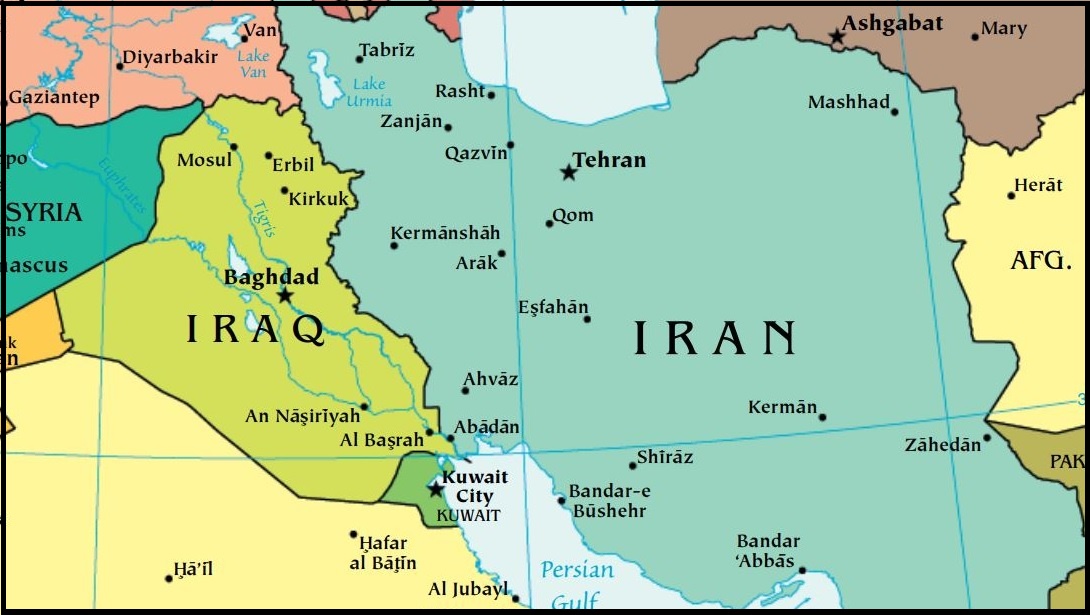
Prior to getting into The Five Themes of Geography, it is best we make a clear distinction between Iran and Iraq to better help us understand their similarities and differences. Let’s refer to the table below for some baseline geographical facts on the two of them (Iran vs. Iraq).
| Location | Middle East, bordering the Gulf of Oman, the Persian Gulf, and the Caspian Sea, between Iraq and Pakistan | Middle East, bordering the Persian Gulf, between Iran and Kuwait |
| Geographic coordinates | 32 00 N, 53 00 E | 33 00 N, 44 00 E |
| Map references | Middle East | Middle East |
| Area | total: 1,648,195 sq km land: 1,531,595 sq km water: 116,600 sq km | total: 438,317 sq km land: 437,367 sq km water: 950 sq km |
| Area – comparative | almost 2.5 times the size of Texas; slightly smaller than Alaska | slightly more than three times the size of New York state |
| Land boundaries | total: 5,894 km border countries (7): Afghanistan 921 km, Armenia 44 km, Azerbaijan 689 km, Iraq 1,599 km, Pakistan 959 km, Turkey 534 km, Turkmenistan 1,148 km | total: 3,809 km border countries (6): Iran 1,599 km, Jordan 179 km, Kuwait 254 km, Saudi Arabia 811 km, Syria 599 km, Turkey 367 km |
| Coastline | 2,440 km; note – Iran also borders the Caspian Sea (740 km) | 58 km |
| Climate | mostly arid or semiarid, subtropical along Caspian coast | mostly desert; mild to cool winters with dry, hot, cloudless summers; northern mountainous regions along Iranian and Turkish borders experience cold winters with occasionally heavy snows that melt in early spring, sometimes causing extensive flooding in central and southern Iraq |
| Terrain | rugged, mountainous rim; high, central basin with deserts, mountains; small, discontinuous plains along both coasts | mostly broad plains; reedy marshes along Iranian border in south with large flooded areas; mountains along borders with Iran and Turkey |
| Natural resources | petroleum, natural gas, coal, chromium, copper, iron ore, lead, manganese, zinc, sulfur | petroleum, natural gas, phosphates, sulfur |
| Land use | agricultural land: 30.1% arable land 10.8%; permanent crops 1.2%; permanent pasture 18.1% forest: 6.8% other: 63.1% (2011 est.) | agricultural land: 18.1% arable land 8.4%; permanent crops 0.5%; permanent pasture 9.2% forest: 1.9% other: 80% (2011 est.) |
| Natural hazards | periodic droughts, floods; dust storms, sandstorms; earthquakes | dust storms; sandstorms; floods |
| Environment – current issues | air pollution, especially in urban areas, from vehicle emissions, refinery operations, and industrial effluents; deforestation; overgrazing; desertification; oil pollution in the Persian Gulf; wetland losses from drought; soil degradation (salination); inadequate supplies of potable water; water pollution from raw sewage and industrial waste; urbanization | government water control projects drained most of the inhabited marsh areas east of An Nasiriyah by drying up or diverting the feeder streams and rivers; a once sizable population of Marsh Arabs, who inhabited these areas for thousands of years, has been displaced; furthermore, the destruction of the natural habitat poses serious threats to the area’s wildlife populations; inadequate supplies of potable water; development of the Tigris and Euphrates rivers system contingent upon agreements with upstream riparian Turkey; air and water pollution; soil degradation (salination) and erosion; desertification |
| Population distribution | population is concentrated in the north, northwest, and west, reflecting the position of the Zagros and Elburz Mountains; the vast dry areas in the center and eastern parts of the country, around the deserts of the Dasht-e Kavir and Dasht-e Lut, have a much lower population density | population is concentrated in the north, center, and eastern parts of the country, with many of the larger urban agglomerations found along extensive parts of the Tigris and Euphrates Rivers; much of the western and southern areas are either lightly populated or uninhabited |
Loads of information there! Throughout the remainder of this page we will go develop a deeper geographical understanding of these two countries. While American’s usually have a picture of war torn desert villages attached ideas of the Middle East, they might be surprised to learn of the urban cities of Bahgdad and Tehran. Many of us are ignorant of the different forms of Islam practiced throughout The Middle East as well, with the majority of Muslims being Sunnis. Within Iran and Iraq, however, the majority are Shia Muslims (BBC). In a time where the American government is quite possibly gearing up for a war with Iran, we can hopefully look past the common notions of the Middle East and see how the peoples in Iran and Iraq are dealing with the world around them(The Economist).
Works Cited
“Iran vs. Iraq.” Iran vs. Iraq – Geography Comparison, http://www.indexmundi.com/factbook/compare/iran.iraq/geography.“Sunnis and Shia in the Middle East.”
BBC News, BBC, 19 Dec. 2013, http://www.bbc.com/news/world-middle-east-25434060.“The Brewing Conflict between America and Iran.” The Economist, The
Economist Newspaper, 9 May 2019, http://www.economist.com/leaders/2019/05/09/the-brewing-conflict-between-america-and-iran.
 Human Geography: The Five Themes of Geography